
Gypsum Board Installation Process – Step-by-Step Complete Guide
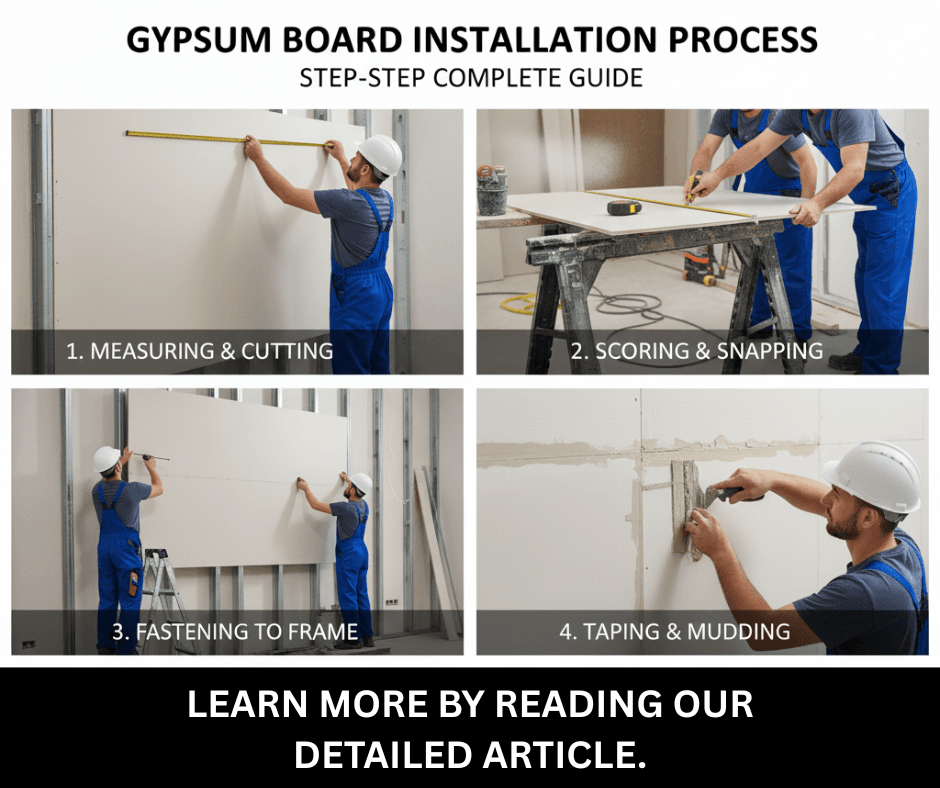
Gypsum board installation is a fast, clean, and cost-effective solution for ceilings and partition walls. In this guide, we explain the step-by-step gypsum board installation process commonly used in homes, offices, and commercial projects.
Step 1: Area Measurement & Planning
Before starting the installation:
- Take accurate measurements of the wall or ceiling
- Plan electrical points, AC ducts, and lighting layout
- Decide whether to use standard, moisture-resistant, or fire-resistant gypsum boards
✔️ Proper planning helps reduce material waste and installation errors.
Step 2: Metal Framework Installation
Gypsum boards are not fixed directly to the wall. First, a GI metal framework is installed.
Framework Components:
- Main channel
- Furring channel
- Angle channel
- Suspension rods (for ceilings)
✔️ The framework must be strong, properly aligned, and perfectly level.
Step 3: Electrical & Plumbing Work
After the framework installation:
- Electrical wiring
- Switch boxes
- AC drainage or plumbing pipes
⚠️ All electrical and plumbing work must be completed before fixing the gypsum boards.
Step 4: Gypsum Board Fixing
Gypsum boards are then fixed onto the metal framework:
- Cut the boards to the required size
- Fix them using drywall screws
- Screw spacing is usually 8–12 inches
✔️ Ensure all board joints are properly aligned for a clean finish.
Step 5: Joint Taping & Filling
For smooth and crack-free finishing:
- Apply joint tape on board joints
- Use joint compound (putty)
- Apply 2–3 coats as required
✔️ Proper joint filling is essential to avoid cracks and visible joints.
Step 6: Sanding & Surface Preparation
Once the putty is completely dry:
- Sand the surface smoothly
- Remove uneven areas
- Clean the surface to prepare it for painting
Step 7: Primer & Painting
In the final stage:
- Apply primer
- Finish with the desired paint or texture
🎨 This step gives the ceiling or wall its final, polished look.
Gypsum Board Installation Benefits
- Fast installation
- Lightweight material
- Fire and moisture-resistant options
- Smooth and modern finish
- Cost-effective solution
Common Mistakes to Avoid
❌ Uneven metal framework
❌ Low-quality screws
❌ Improper joint filling
❌ Using normal gypsum boards in moisture-prone areas
Conclusion
Gypsum board installation is a professional process that delivers long-lasting results when done with proper planning and quality materials. If you are looking for high-quality gypsum boards, metal profiles, and accessories, RukunLava is your trusted building materials supplier in Saudi Arabia.
Contact Us:
Phone : +96655 043 4133
Email : info@rukunlava.com
Website : Rukunlava.com
